
Run the plant
Facility owners & operators
Operators and maintenance teams who need the right document, fast.
Answers from your own manuals, P&IDs and data.
AI that reads your manuals, P&IDs and plant data, and gives engineers answers grounded in technical evidence.
 Illustrative

Hall B cooling is 21 °C, within the target range of 18 to 24 °C.
The same question, asked on the same plant. One side opens source after source. The other asks PlantTalk.
Low-suction trip setpoint and troubleshooting procedure
8 minPT-1014 on the pump suction line, with its process relationships
9 minSignal path from TB-3 terminal 7 to the PLC input
12 minInstrument datasheet with cross-references to other drawings
9 minLive value, 24-hour history, alarms and events
9 min PlantTalkIllustrative
It trips at the low-suction setpoint in the pump manual. The trip is read by PT-1014 on the suction line, wired from TB-3 terminal 7 to the PLC input. Check PT-1014's live value and recent alarms before restarting.
Manuals, P&IDs and electrical drawings each hold part of the answer. Our industrial RAG architecture finds the right pieces and puts them together, step by step. We measure answer accuracy, evidence retrieval, ranking quality and processing efficiency on technical benchmarks and industrial document collections.
An operator or engineer asks in plain language.
Looks through all your sources at once.
Puts the most relevant evidence first.
Keeps what matters, with tables and figures in context.
The AI assistant replies and cites its sources.
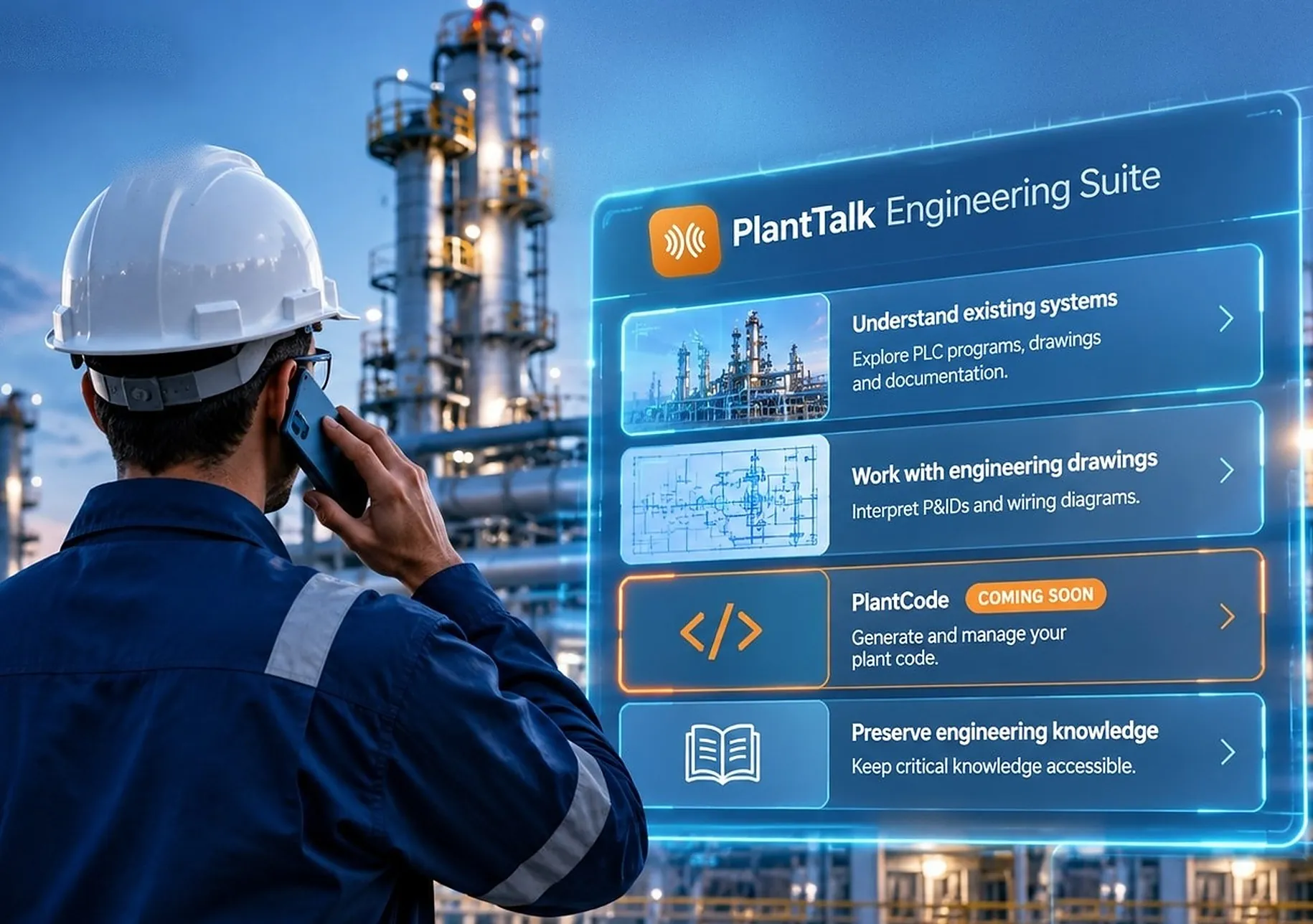
Being built to help engineers understand existing automation projects and speed up selected technical workflows.
Industrial AI built for production, where precision is non-negotiable: critical infrastructure, process plants and power grids.
Learns a system's normal behavior from its own telemetry, with no labeled failures, and alerts the moment operation drifts. It doesn't just flag that something is wrong: it pinpoints which variable is driving it.
Turns P&IDs, typically PDFs or scans, into a structured plant model: equipment, instruments, valves and the process connections between them. Deterministic and auditable, with computer-vision symbol detection and multi-engine OCR following the ISA convention.
Builds dynamic models of distribution grids from PMU synchrophasors and synchrowaveforms. Instead of nameplate assumptions, we identify the grid's actual impedances and dynamics with physically consistent models, validated against open datasets of real grids.
Four roles, one need: technical answers grounded in the plant's own documents and data. PlantTalk gives each of them the same foundation, across every process industry.
Operators and maintenance teams who need the right document, fast.
Answers from your own manuals, P&IDs and data.

Teams delivering and supporting automation projects.
Faster understanding of client systems, with documentation that stays usable.

Teams that interpret, maintain and evolve complex engineering projects.
Technical evidence at hand: drawings, specifications and project files.
Companies building specialized AI applications and integrations.
A ready PlantTalk foundation to build on, instead of starting from zero.
P&IDs, instrumentation and control-system context.
Equipment, procedures and operating data.
Manuals, specifications and PLC-connected systems.
Data centers and other process-intensive industries.
Four applications with distinct roles, working together as one industrial intelligence experience.
Flagship

 Coming soon
Industrial AI must understand the environments it operates in. We bring together industrial automation, control systems, software engineering and artificial intelligence, with the goal of making industrial knowledge more accessible, useful and actionable.
Automation Labs — Industrial Intelligence. Engineered for the Real World.